Health Savings Accounts (HSAs) and Flexible Spending Accounts (FSAs) are two of the most valuable tax-advantaged benefits employers can offer — yet they are frequently misunderstood, conflated, or underutilized. As an HR professional, understanding the key distinctions between these two account types will help you guide employees toward informed enrollment decisions and ensure your benefits communication is accurate and effective.
What Is an HSA?
A Health Savings Account (HSA) is a tax-advantaged savings account available to employees enrolled in a qualified High-Deductible Health Plan (HDHP). Contributions are made pre-tax, funds grow tax-free, and withdrawals for qualified medical expenses are not taxed — making the HSA one of the few triple-tax-advantaged financial tools available.
Key characteristics of an HSA:
-
Eligibility is strictly tied to HDHP enrollment. Employees covered under a non-HDHP plan, enrolled in Medicare, or claimed as a dependent on another’s tax return are not eligible.
-
The account is owned by the employee, not the employer. If an employee leaves the organization, the HSA goes with them.
-
Funds roll over from year to year with no expiration.
-
Once the balance reaches a threshold (typically $1,000), many HSA administrators allow funds to be invested in mutual funds or other investment vehicles.
-
For 2026, the IRS contribution limits are $4,400 for individual coverage and $8,750 for family coverage. Employees age 55 or older may make an additional $1,000 catch-up contribution.
What Is an FSA?
A Flexible Spending Account (FSA) is an employer-established benefit that allows employees to set aside pre-tax dollars for qualified medical expenses. Unlike HSAs, FSAs are not tied to a specific health plan type, making them more broadly accessible.
Key characteristics of an FSA:
-
Employees do not need to be enrolled in an HDHP to participate in a general-purpose healthcare FSA.
-
The account is owned by the employer. If an employee leaves mid-year, any unused funds typically remain with the employer.
-
FSAs are subject to the use-it-or-lose-it rule. For 2026, employers may offer either a rollover of up to $680 or a 2.5-month grace period — but not both, and neither option is required.
-
The 2026 employee contribution limit is $3,400. The full elected annual amount is available on day one of the plan year, regardless of how much has been contributed to date.
-
FSA funds cannot be invested and do not earn interest.
Can Employees Have Both?
Generally, an employee cannot contribute to both an HSA and a general-purpose FSA simultaneously, as the FSA is considered a disqualifying coverage under IRS rules. However, there are two FSA variants that are compatible with HSA enrollment:
-
Limited-Purpose FSA: Covers only vision and dental expenses, preserving HSA eligibility.
-
Dependent Care FSA: Covers eligible dependent care costs (e.g., childcare, elder care) and does not affect HSA eligibility.
HR teams should clearly communicate these nuances during open enrollment to prevent employees from inadvertently disqualifying themselves from HSA contributions.
Practical Guidance for HR Professionals
When administering these benefits and supporting employee education, keep the following in mind:
-
Audit plan pairings annually. Confirm that employees enrolled in an HSA are only offered HDHP options and that any FSA offered alongside an HDHP is limited-purpose.
-
Educate during open enrollment. Many employees are unaware of the rollover and portability differences. A brief comparison document or benefits walkthrough can prevent confusion and increase plan satisfaction.
-
Remind employees of FSA deadlines. Use-it-or-lose-it rules create year-end pressure. Proactive reminders in Q4 can reduce forfeitures and improve employee perception of the benefit.
-
Clarify employer contribution strategies. Employer HSA contributions are a powerful recruitment and retention tool. If your organization contributes to HSAs, ensure this is prominently featured in benefits materials.
-
Stay current on IRS limits. Contribution limits adjust annually. Update payroll systems, benefits portals, and employee communications each plan year.
Side-by-Side Comparison
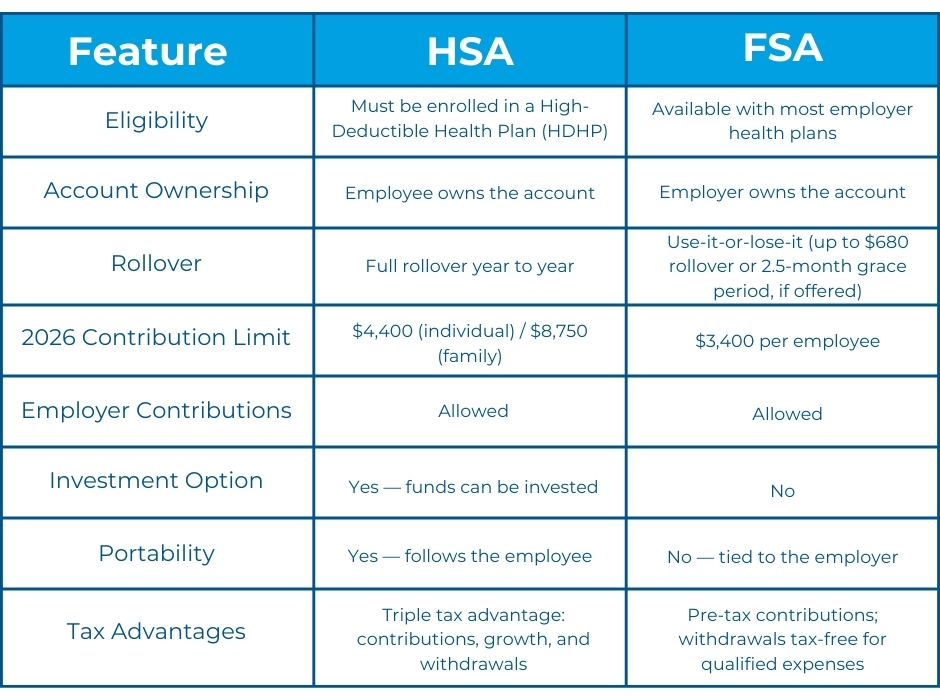
The table below summarizes the primary differences between HSAs and FSAs:
Qualified Medical Expenses
Both HSAs and FSAs cover a broad range of IRS-qualified medical expenses, including but not limited to: deductibles and copayments, prescription medications, dental and vision care, mental health services, and certain over-the-counter medications. The CARES Act of 2020 permanently expanded eligible OTC expenses to include items such as pain relievers, cold medicine, and menstrual care products without a prescription.
Employers should direct employees to IRS Publication 502 for a comprehensive list of qualified medical expenses, and confirm that their HSA or FSA administrator provides up-to-date guidance.
Takeaway
HSAs and FSAs each offer meaningful tax advantages, but they serve different employee populations and carry different rules around ownership, portability, and fund expiration. As an HR professional, your ability to clearly explain these distinctions — particularly during open enrollment — directly impacts how effectively employees can utilize their benefits.
When in doubt, consult with your benefits broker or legal counsel to ensure your plan offerings are compliant and aligned with employee needs.
The post HSA vs FSA: What HR Professionals Need to Know appeared first on The Accel Group.