From Our Agribusiness Team
As farmers wrap up harvest and begin planning for the next crop year, there are some important farm program decisions worth putting on the calendar. One of those is choosing between Agriculture Risk Coverage (ARC) and Price Loss Coverage (PLC).
While both programs are designed to help protect farm revenue, they work differently. Understanding those differences, along with current market conditions and your farm's individual yield history, can help you make a more informed decision.
So, should you choose ARC County, ARC Individual or PLC? The answer depends on your operation, your county's yields and where commodity prices may be headed.
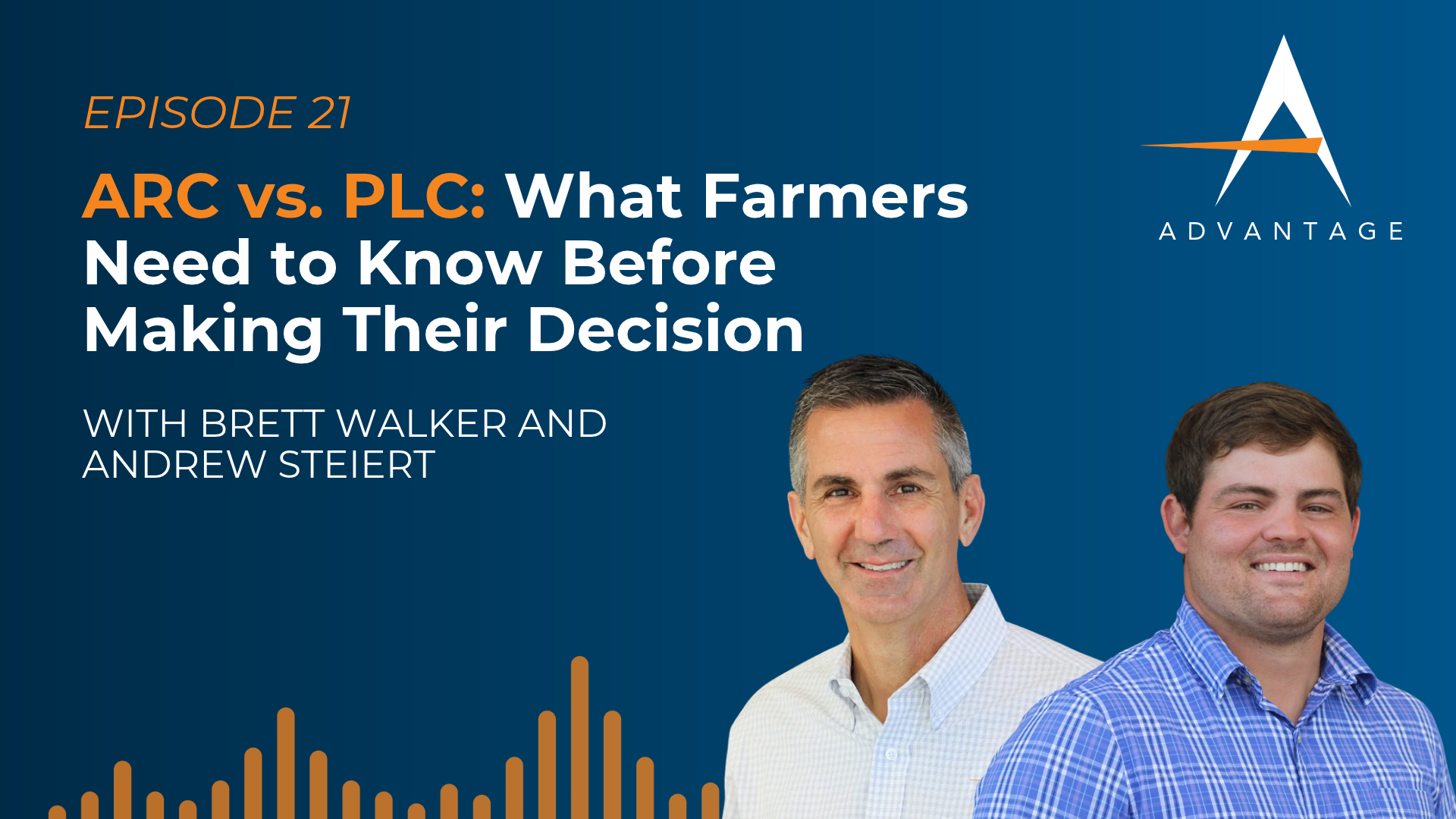
Our Agribusiness members Brett Walker and Andrew Steiert recently sat down to break down the options and share what farmers should consider.
What Is the Difference Between ARC and PLC?
The biggest difference between ARC and PLC is what triggers a potential payment. ARC is based on revenue losses, while PLC is based primarily on commodity prices falling below established reference prices.
Here's a closer look at each option.
What Is ARC County (ARC-CO)?
Agriculture Risk Coverage – County (ARC-CO) is a revenue-based program that considers both commodity prices and county-level yields.
A potential payment is triggered when the actual county revenue for a covered crop falls below a calculated benchmark revenue.
Because it accounts for both price and yield, ARC County can provide a layer of protection if either one declines enough to cause a revenue shortfall.
Brett and Andrew noted that ARC County may be a good starting point for many Iowa farmers because it considers both factors. However, the right choice depends on the individual operation and the conditions within each county.
What Is ARC Individual (ARC-IC)?
ARC Individual is another revenue-based option, but instead of looking at county-level revenue, it evaluates revenue across an entire farm's covered commodities.
This option may be worth considering when a farm has experienced significantly different yield results than the surrounding county.
For example, if a particular farm experienced a substantial yield loss while the rest of the county had a strong year, ARC Individual may be worth a closer look.
However, there are some important details to understand:
- Farm-level reporting: ARC Individual is calculated using farm-level information rather than county averages. Farms are evaluated based on their FSA farm number and applicable program requirements.
- Combined crop revenue: Revenue from covered commodities, including corn and soybeans, is considered together. A strong result in one crop could help offset a loss in another.
- Payment acres: ARC Individual generally uses 65% of base acres to calculate payment acres, compared with 85% for ARC County.
As Andrew explained, this option may make sense when a farm's performance is significantly different from the county trend. But it isn't necessarily the best fit simply because one field or farm had a poor yield year.
What Is Price Loss Coverage (PLC)?
Price Loss Coverage (PLC) is primarily a price-based program.
Unlike ARC, which considers both price and yield, PLC provides potential payments when the effective price for a covered commodity falls below its effective reference price.
For the 2026 crop year, the effective reference price for corn is $4.42 per bushel.
This makes PLC an option worth evaluating for farmers who are concerned about commodity prices declining.
Brett and Andrew discussed how the decision between ARC and PLC can become less clear as projected prices and county yields change. Their conversation highlighted how important it is to look at current market conditions rather than relying on assumptions from previous years.
How Do Market Conditions Affect the ARC vs. PLC Decision?
Commodity prices and county yields are two important pieces of the ARC and PLC decision.
During their discussion, Brett and Andrew pointed to recent market activity, including changes in projected ending stocks for corn and soybeans, as factors worth watching.
A stronger price outlook may influence which program provides more potential protection. On the other hand, declining prices could make PLC more attractive, depending on the effective reference price and other program calculations.
County yields also matter, particularly when evaluating ARC County.
There isn't one program that automatically works best for every farmer. The decision should be based on your operation's circumstances, county-level yield trends and current price projections.
The Accel Group Ag team continues to evaluate local county yield information to help farmers better understand how these factors could affect their options.
Should Farmers Choose a Multi-Year ARC or PLC Election?
Another consideration for the 2026 and future crop years is whether to make an annual election or select a multi-year agreement.
USDA has made multi-year elections available for the 2026 through 2031 crop years.
While this option may reduce the need to revisit the decision every year, Brett and Andrew shared why they believe farmers should think carefully before committing to multiple years.
Agricultural markets are constantly changing. Commodity prices, production trends and county yields can look very different from one year to the next.
Their recommendation is to consider keeping the decision on an annual basis so farmers have the opportunity to reevaluate their options as conditions change.
A multi-year election may offer convenience, but it's important to weigh that against the flexibility of making a new decision each year.
What Are the ARC and PLC Enrollment Deadlines?
Farmers should keep the following USDA Farm Service Agency (FSA) deadlines in mind:
| Crop year | Election and enrollment deadline |
|---|---|
| 2026 | December 11, 2026 |
| 2027 | March 15, 2027 |
For the 2026 crop year, producers can change their existing election and enroll in ARC County, ARC Individual or PLC.
It's important to understand that even if you decide to keep your previous program election, you still need to complete the required enrollment process. According to FSA, farms that do not submit a 2026 election by December 11 will retain their 2025 election but will be ineligible for 2026 program payments.
Producers considering a multi-year election should also understand how that agreement affects future enrollment decisions.
Contact your local FSA office for enrollment requirements and assistance.
Where Can Farmers Find More Information About ARC and PLC?
Making an informed decision means looking beyond the program names and understanding how each option could apply to your operation.
Brett and Andrew recommend using resources such as:
- USDA Farm Service Agency (FSA): Official program information, enrollment requirements and deadlines.
- Kansas State University: Agricultural economics and farm program resources.
- Iowa State University Extension and Outreach – Ag Decision Maker: Farm program information and tools to compare ARC and PLC payment estimates using county-specific data.
Working through the numbers with someone familiar with your operation can also help you understand the differences between the available options.
Have Questions About Your ARC and PLC Options?
Every farm is different, and choosing between ARC County, ARC Individual and PLC deserves a closer look at your operation's specific circumstances.
Our Ag team is here to help farmers understand the options, evaluate what's changing in the marketplace and make informed decisions about managing agricultural risk.
If you have questions about ARC or PLC for the 2026 or 2027 crop years, reach out to The Accel Group Ag team. We're happy to walk through the considerations with you.
Continue the conversation
Listen to the full episode here
Email our ag team at mmartin@acceladvantage.com
Call us at 319.483.4854
Primary keywords:
- ARC vs PLC
- ARC and PLC programs
- ARC County
- ARC Individual
- Price Loss Coverage (PLC)
- Agriculture risk management
- Farm program decisions
- 2026 crop year
- 2027 crop year
Secondary keywords: - USDA farm programs
- Farm safety net programs
- Crop year planning
- County yield
- Marketing year average price
- Farm revenue protection
- Iowa farmers
- Agricultural risk management
- Farm program enrollment deadlines
- ARC PLC election